Tian Yuan Dong: After co-writing the last paper with GPT-5, I realized that I would be unemployed within 5 years.
A while ago, OpenAI released 722 mathematical paper manuscripts on GitHub in one go. These manuscripts were grouped into 372 different "families," covering 17 different fields of mathematics, and all of them come from a yet-to-be-released paper that does not have a public name.Internal Model——Its performance far surpasses that of GPT-6 Astra.
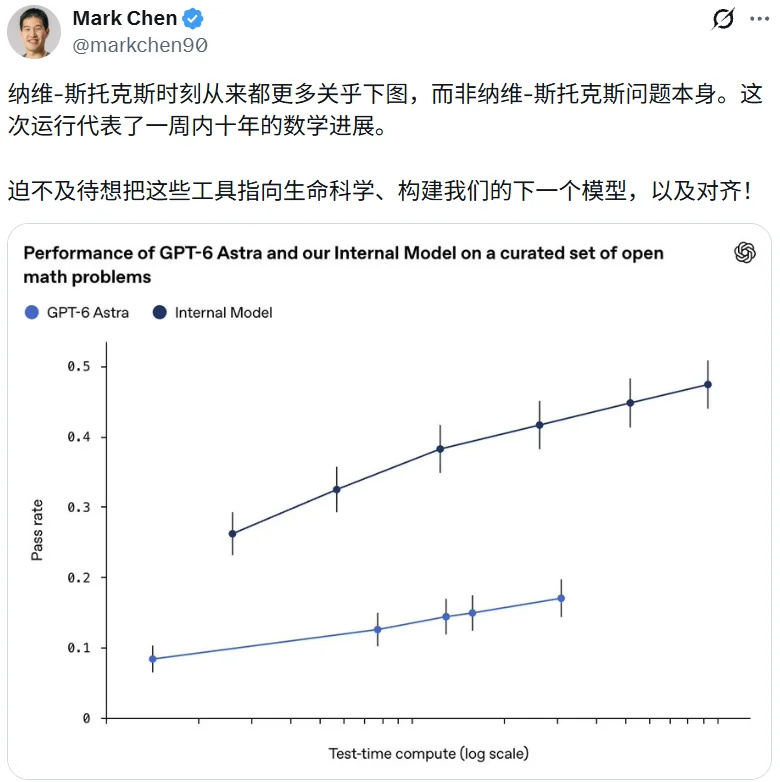
Tweet from Mark Chen, Chief Research Officer of OpenAI
Of course, there are still many debates in the mathematics community regarding the quality of these findings and the way they were disclosed, but one thing is hard to deny:The speed at which AI generates research results has begun to be measured in units of "hundreds of papers."。
Almost at the same time, in the latest episode of the The Information Bottleneck podcast, a veteran in the field of deep learning made a statement that caused quite a stir among researchers: “After completing this project and obtaining some interesting results, I suddenly realized: Wow...”My job is likely to be replaced within about five years.。」
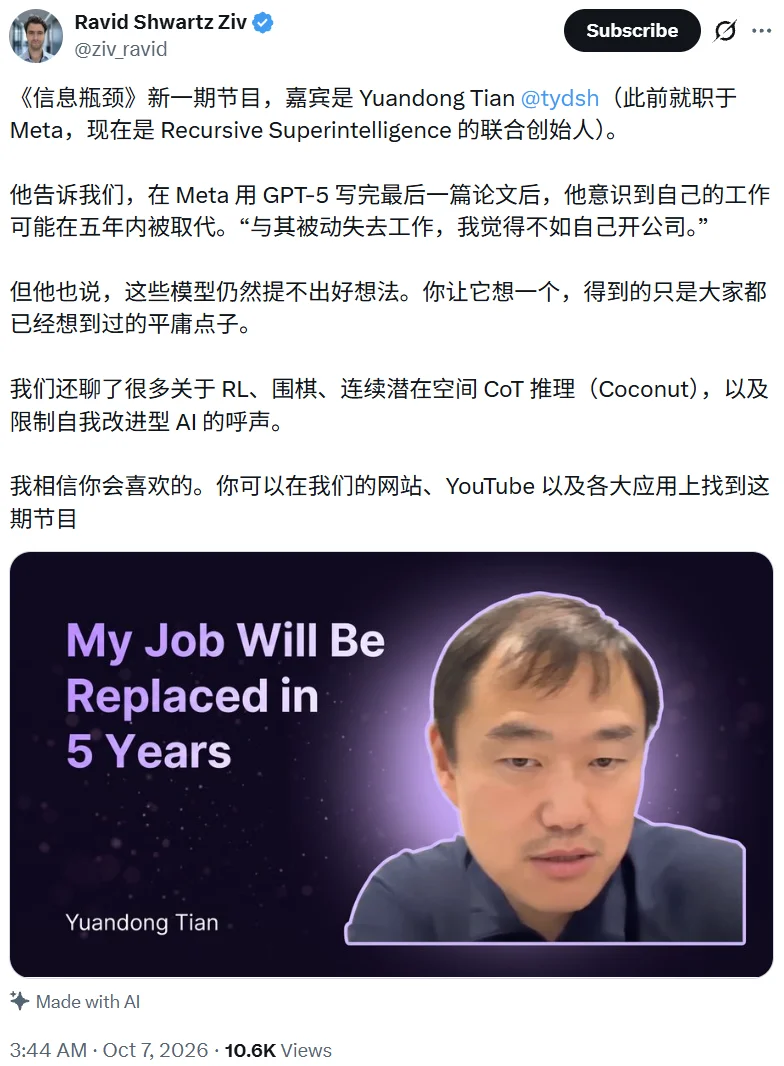
Podcast Address: https://www.the-information-bottleneck.com/p/yuandong-tian-on-recursive-self-improvement-600
The person who said this wasTian Yuan DongHe has been at Meta FAIR for nearly a decade, working on Go AI, reinforcement learning, and the interpretability of neural networks. He is also one of the authors of the paper on Coconut (a continuous latent space thought process).
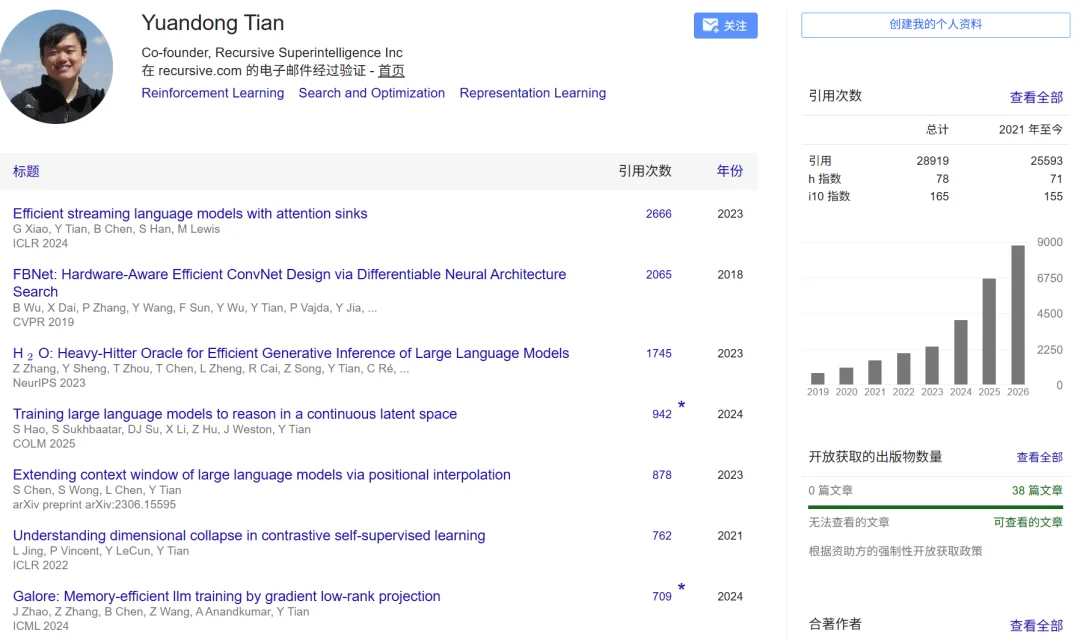
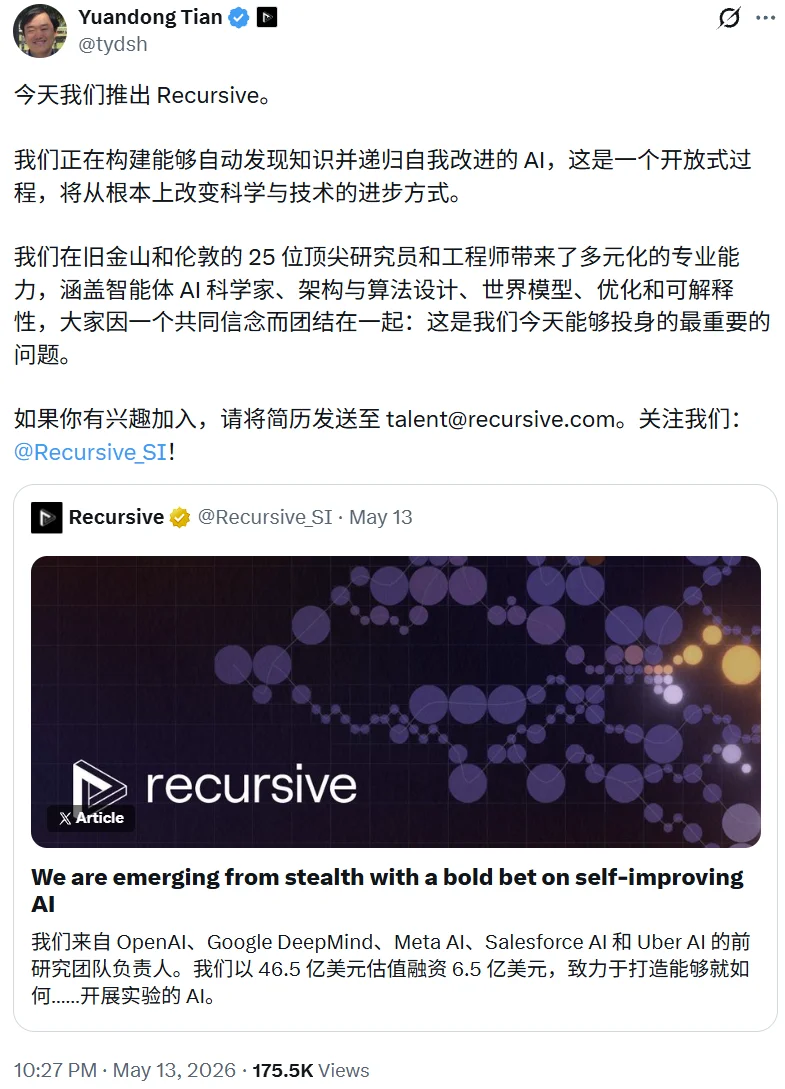
Today, his identity is Recursive Superintelligence Co-founder of [Company Name]. In May this year, the company ended its stealth mode and announced the completion of a financing round of over $650 million at a valuation of $4.65 billion, led by GV and Greycroft, with participation from NVIDIA and AMD.
In this episode of the podcast hosted by Ravid Shwartz-Ziv, Mifune Takahide explained why he decided to start his own business:Rather than passively losing our jobs, it would be better to take the initiative and start a company that moves in this direction.However, he also poured some cold water on AI during the program. “If you let the model come up with its own ideas, it will come up with some very mediocre suggestions that basically everyone knows about, and they’re not particularly interesting either.”
During the nearly one-hour conversation, Tagawa Masaaki discussed a wide range of topics, from AlexNet from his time at CMU to Go AI, from the concept of "action space" to latent space reasoning, and finally touched on recursive self-improvement, new architectures, and open-source development. The following is a summary of this conversation.
The argument in Smith Hall: Was AlexNet really an accident?
Tian Yuan Dong came to the United States in 2008 to pursue a Ph.D. at the Robotics Institute at Carnegie Mellon University. At that time, machine learning was not as prominent as it is today. “Many people didn’t think machine learning was a viable path; they doubted its effectiveness because of issues like overfitting and a lack of understanding of the underlying mechanisms.”
His doctoral research topic was in the field of computer vision.Non-convex optimization problemsFor example, restoring the image distortion caused by water surface refraction. He used a layered approach to optimize the problem and demonstrated that even if the problem is non-convex, as long as there is enough data, it is still possible to prove optimality to some extent. “The combination of data-driven methods and optimization is quite interesting; I’m still quite proud of this work.”
In 2012, AlexNet made its debut. Tanihara Masaaki sent an email to Alex Krizhevsky and obtained the code to experiment with on his own. He quickly realized that the hierarchical processing of convolutional networks was essentially the same as the concept of hierarchical optimization he had discussed in his paper; “It might be exactly what I’ve been searching for, just presented in a different form.”
But the atmosphere at CMU at that time was not friendly. “Everyone came to the office every day and had intense debates in Smith Hall about whether the results of AlexNet were just a fluke or a real breakthrough. Most people thought it was just a fluke, because it didn’t make sense.”
When he graduated in 2013, Mita Mifune received offers from several companies interested in deep learning, but he ultimately chose to join Google's autonomous driving team. Part of the reason was the company's reputation, and another part was the recommendation from a friend. However, during his one year and three months there, he was unable to work on deep learning projects because the team was more like a startup, focusing on using established solutions to address practical problems rather than engaging in scientific research. As a result, he switched to FAIR, calling it "one of the best decisions he ever made."
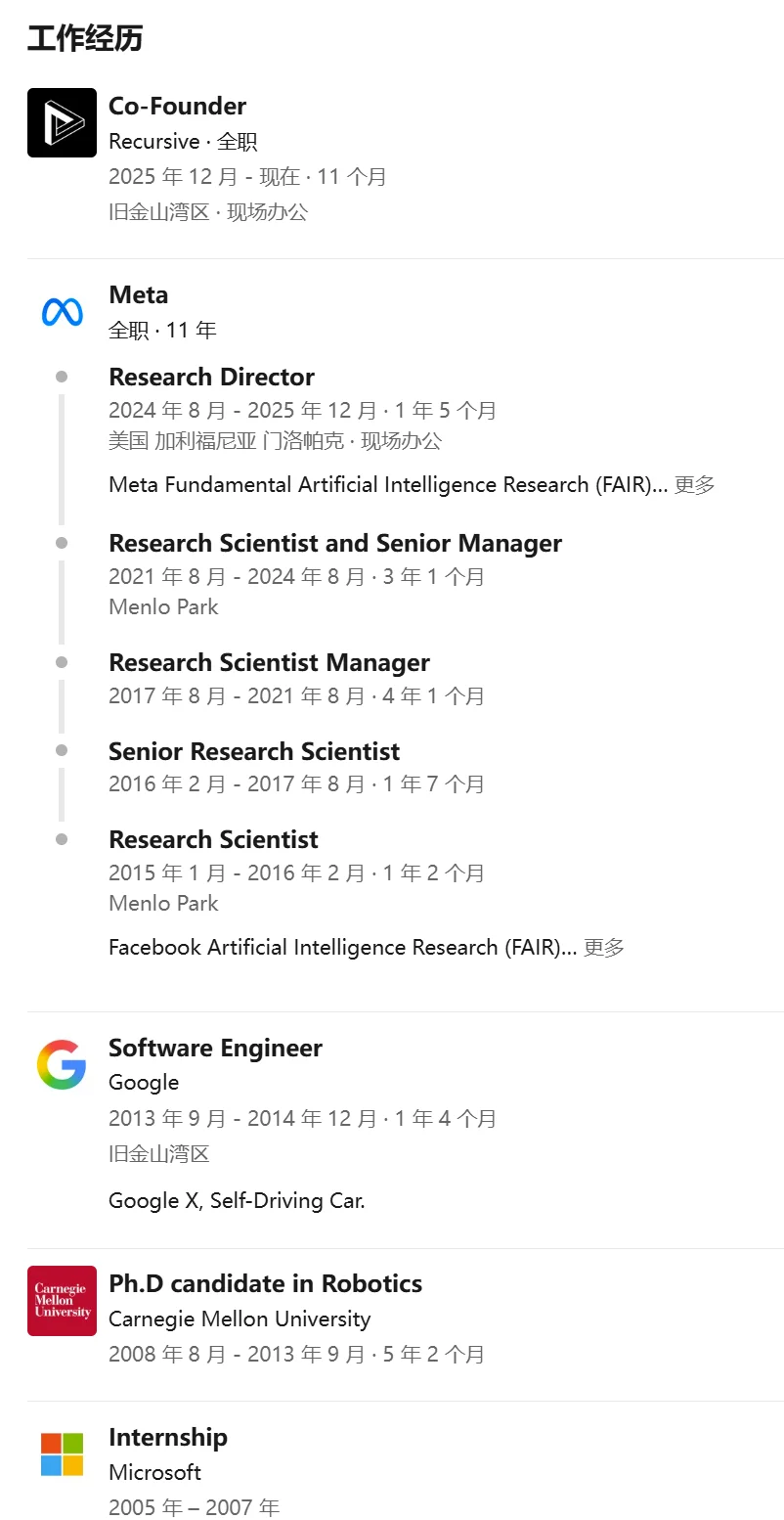
Two people, one GPU: Tian Yuandong's past experiences with Go
At FAIR, the first project initiated by Takahashi Takao was related to Go AI. In 2015, his team made significant progress in this area. DarkForestIt defeated top amateur players online using a convolutional neural network. A few months later, in the spring of 2016, AlphaGo defeated professional players.
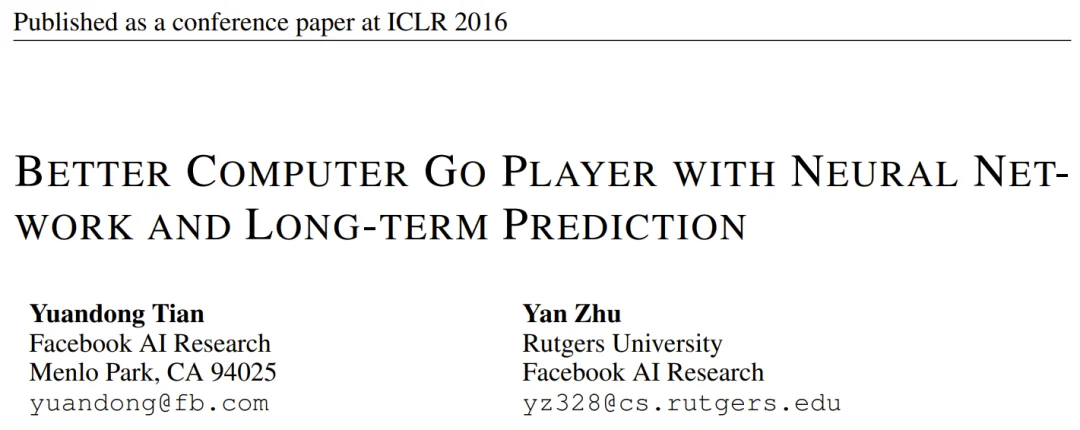
In the face of such a "collision," Tanihara Tatsuya believed that AlphaGo had two aspects that AlphaGo did not possess:
- Value NetworkAt that time, DarkForest only had a policy network;
- He himself had hardly any... before.Reinforcement LearningBackground: "Basically, I learned while I was doing it, just like I was training myself in reinforcement learning." This experience led him to later focus on a large amount of research in reinforcement learning.
When asked whether AlphaGo was surprising, his answer was quite interesting: The method itself was not astonishing, becauseConvolutional networks are able to capture the board patterns that humans rely on when playing chess.What's really surprising is that it's actually able to defeat professional chess players.
In 2018, the team reproduced AlphaZero, which is a system that can play chess entirely on its own without relying on any human game records, and made some efficiency improvements. As a result, they achieved... OpenGoThis AI, in an official match against the Korean Go Association, used only one V100 GPU and managed to prevent all four professional players from winning a single game. "I think that's probably..."For the first time, someone has defeated a professional chess player using a single GPU.。」

There was a small incident before the competition. The team asked professional and semi-professional chess players to evaluate the strength of OpenGo. The response was that they could understand the opening moves, but after that, they couldn't follow the game at all, and could only say, “It looks very strong, but I’m not sure if it really is.” As a result, Tagawa Tadao decided to play a game against a real professional chess player directly.
Action space is more important than the algorithm itself.
When it comes to reinforcement learning in that era, Tagawa Masaaki believes that...There are quite a few methods that are still underestimated to this day.For exampleDistributed Reinforcement LearningAdjust the model using the distribution of rewards rather than a single scalar; for example, Different modeling methods such as Q-learning「But now, most of the time we use policy gradients, which represents a very different era。」
He is also optimistic about it.No gradient optimization methodsMoreover, it is believed that large models have opened up new possibilities: “Large models now have a better high-level understanding of the systems and the target functions that need to be optimized, which is much more useful than local gradient information.” In situations where gradients fluctuate dramatically and local optima are common, gradients can lead one into a dead end, whereas gradient-free methods inherently include the element of exploration, “something that gradient methods have never been able to do.”
Around 2018 and 2019, Mihara Takahide began experimenting with applying reinforcement learning to real-world problems, and the conclusions were quite surprising:What really matters is not the algorithm, but the design of the action space and the state space.」
He took neural architecture search as an example. Humans understand that the depth of the network is crucial, but AI doesn’t. If AI starts by searching for details such as the size of the first-layer convolutional kernels, all branches will perform similarly, and the value function won’t provide any useful information. In this case, trying to search deeper layer by layer will lead to an exponential increase in the search space, and “no algorithm will be useful at that point.” On the other hand, if the action space can be reorganized so that AI first “realizes” the importance of depth, there will be a clear contrast between deep and shallow networks, and the direction of development can be identified after just a few iterations. Based on this, the team proposed…Latent Space Monte Carlo Tree Search (LA-MCTS)The core idea is to automatically identify the action space that maximizes the discriminative power of the search subspace.
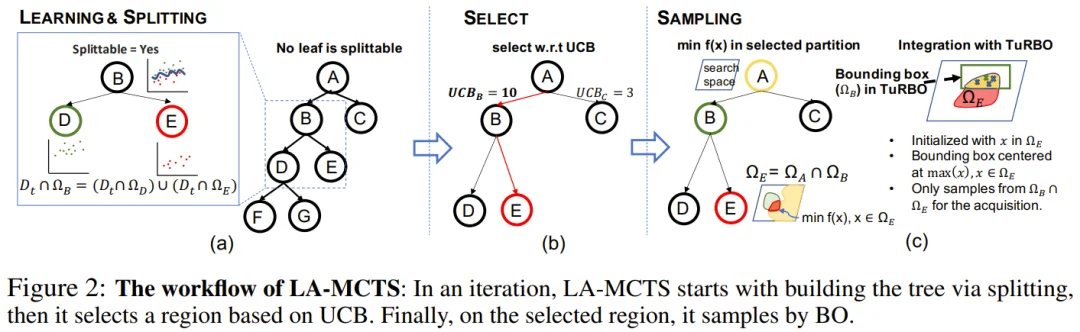
Coconut: “I never use language when I’m thinking.”
The co-host mentioned the participation of Tanihara Takashi. Coconut The paper proposes that models should be trained to reason in continuous latent spaces rather than in token-based spaces. Tanaka Mifune explains that this idea stems from his own observations: “I never use language when I am thinking. I can clearly feel that another part of my brain is involved in the thinking process, and I have to translate those thoughts into language in order to communicate effectively with others.”
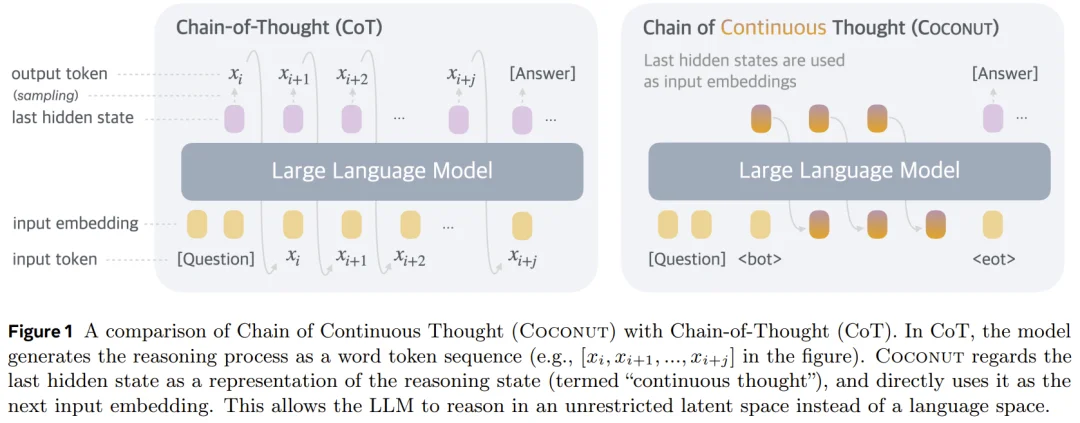
Starting from this intuition, the team conducted theoretical derivations and found that the potential representation could be a superposition of various ideas. Using this approach, they believed they might gain significant advantages in problems such as graph traversal. “Maybe not exponential, but at least some advantage.”
So why haven't cutting-edge models adopted continuous thought chains yet? Tanaka Masaaki gave two reasons for this.
- DataA large portion of human thought processes is recorded in the form of language, but there is no such data available for the subconscious mind (the "latent space").
- Potential representations may be highly personalized.“Everyone is, to some extent, using their own potential representations,” and the learning efficiency of large models is much lower than that of humans, so language has to be used as a substitute for now.
Ravid Shwartz-Ziv asked whether this is similar to the regularization problems faced by self-supervised methods such as JEPA. Tagawa Masaaki agreed and went even further: Gradient descent may itself be trapped in a kind of “meta-level local optimum”; there are some excellent representations that perhaps cannot be learned at all with the current training paradigms. “We don’t know where the boundaries lie right now,” he said.
In his view, this is precisely what...Interpretability ResearchThe significance of this lies in “the difference between alchemy and chemistry.” However, the current models are too powerful, and everyone is focused on the results; there isn’t enough time or people willing to devote themselves to this direction.
After co-writing the last paper with GPT-5
When it comes to the transformation in the era of large models, Tanaka Mifune believes that the analysis of neural network training dynamics that he has been working on since 2018 can still be applied to large models, and there has been no significant break in methodology. The real challenge lies at the empirical level: researchers still propose hypotheses, conduct experiments, and draw conclusions in the same way as they did a hundred or two hundred years ago; there has been no fundamental change in this process.As the model becomes stronger, it will be able to generate its own ideas."The researchers may be forced to think at a meta-level, rather than spending time on proposing individual hypotheses."
At the same time,The status of engineering capabilities has significantly increased.Many good jobs in the era of large models involve “half research and half engineering.” However, things have changed with the emergence of AI programming agents: researchers with solid experience can now enable these agents to quickly implement ideas and identify key issues, “suddenly gaining superpowers to explore truly profound topics.”
The turning point was his last paper at Meta, for which he was the sole author. This paper focused on the study of neural networks. grokking The phenomenon refers to the situation where the network initially memorizes data by rote and then, at a certain point in training, suddenly learns to generalize (i.e., to apply knowledge to new, unseen data).
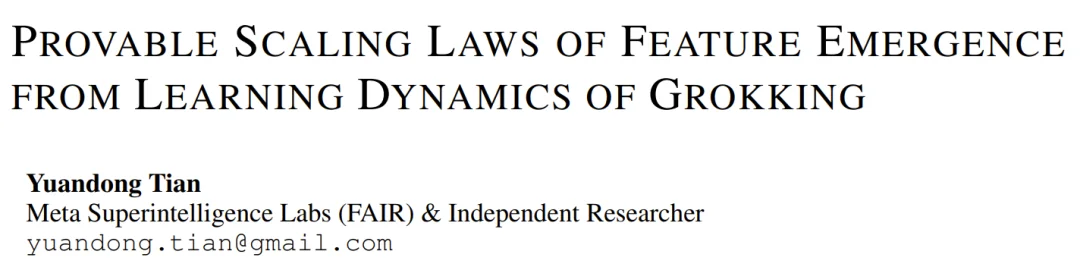
Throughout the entire process,He regarded GPT-5 as a collaborator.Ask it questions, assign it “homework”, and have it prove theorems, check whether the theorems are valid, and brainstorm together.
The result isThe efficiency has increased by approximately 6 to 10 times.“And this is still a conservative estimate, because at that time I was still writing the code myself.” Nowadays, the code and implementation can be handed over to powerful intelligent agents, and the speed will only be faster.
So that's how the opening sentence came about. Tanaka Mifune frankly states that researchers usually don't want to become co-founders of small companies because they have to deal with a lot of things other than research. “But I think this is a turning point; if I do nothing now, it might not matter in the future.”
The co-host responded half-jokingly, saying that her approach was to learn how to do things manually, but unfortunately, “I’m not good at that.”
AI still can't come up with any good ideas.
However, Tagawa Masa does not believe that humans can already withdraw from the situation.I don't think the current models can produce good results without any human intervention.Even for that paper co-written with GPT-5, the overall conceptual framework was provided by him, not by the model itself.
Humans still have to be responsible for:
- InitiateDetermine which problems are worth addressing.
- VerificationTo determine whether the solution proposed by AI is reliable or not
Ravid Shwartz-Ziv mentioned that recent efforts to have agents perform post-training tasks independently and compete on Kaggle have revealed issues such as a narrow range of ideas and a tendency to overfit on metrics. Tanihara Takashi believes that this is somewhat temporary: models are required to handle details but lack context. Providing them with more background information might lead to more interesting ideas than simply adjusting hyperparameters.
But he also acknowledges that adding context is just a “temporary fix.” The current models are good at repetitive tasks because internet data is full of such content;If the model is to truly break out of the constraints of its current framework, a new architecture is needed."Enable it to quickly capture new signals with very little data. 'To move from routine, repetitive work to the next level, we need a significant leap.'"
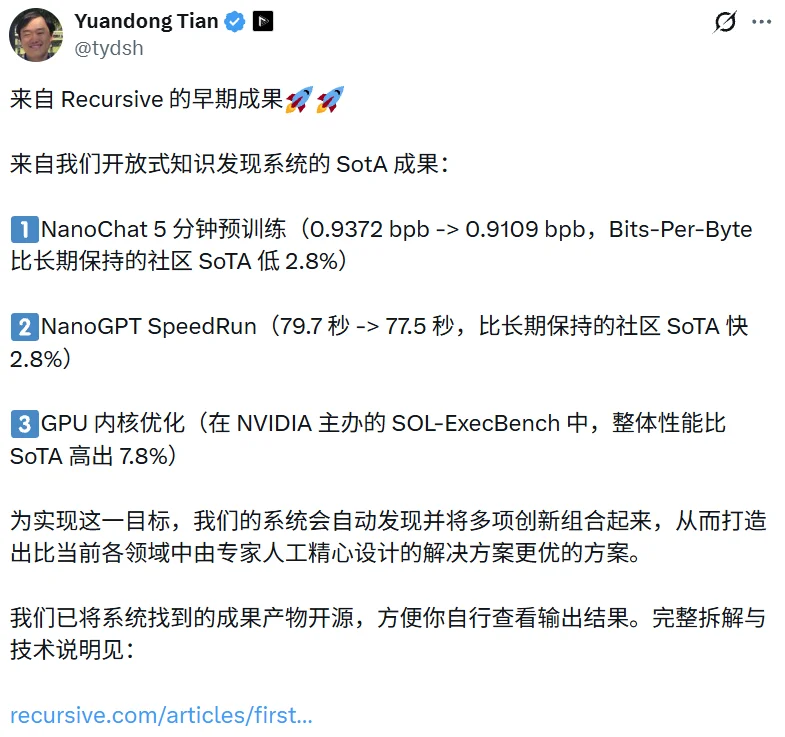
In the research cycle of "coming up with ideas, writing code, conducting experiments, and analyzing results," he believes thatThe most difficult part to automate are ideas.When asked about the achievement of Recursive in the NanoGPT Speedrun – reducing the training time from 79.7 seconds to 77.5 seconds – whether it was a real discovery or just an efficient search for existing techniques, Tanihara Takashi replied that it was a combination of both. For example, the approach of incorporating bigram information into the attention mechanism can be found in similar ideas in DeepSeek, Gemma 3, and even in the STEM paper he participated in at Meta. However, figuring out how to use different embedding tables at different levels and combining these ideas together involved new creativity.
Why do new architectures always “fail” when they are scaled up?
Many companies have proposed alternative architectures to Transformer, which have performed well in small-scale experiments, but have never been able to be scaled to large models. According to Tanihara Takashi's explanation,Inductive BiasWhen the data volume is small, there is not enough information, so additional structural assumptions must be made, which naturally leads to better results. However, as the amount of data increases, the best approach is to let the model find the patterns on its own. He gave the example of ViT: on datasets the size of ImageNet, ViT performs less well than convolutional networks, but when the data volume reaches hundreds of millions, Transformers outperform them.
So, how should the new architecture be verified?
Tian Yuan Dong certainly agrees.Start with a small scale.But the key is to understand what exactly is happening within the network. “We need to know that there is some kind of insight that can be applied on a larger scale, so that we can have confidence.” Otherwise, if we simply blindly follow the scaling law, we will never be able to prove that something that works on a small scale also works on a large scale. “The only outcome will be that the company with the most computing power will win.”
His more long-term goal in his mind isFind a learning efficiency comparable to that of humansThe human brain can understand things in a very short time, using only twenty to thirty watts of power and a very small amount of data. In the field of robotics, the emphasis on the need for massive amounts of data today is simply a requirement of the current paradigm. “Just look at cats and dogs – these physical entities don’t need that much data, and their processors are quite basic yet they can survive in complex environments. There must be new algorithms at work there.”Reinforcement learning and self-improvement may be the fastest way to get there.
Limiting self-improvement? “The boundaries are too vague.”
At the end of the program, the host addressed a hot topic in the field of AI security: some people are calling for restrictions on the latest models and advocating for industry coordination regarding the issue of recursive self-improvement.
Tian Yuan Dong's answer was very straightforward: “To be honest, I think it’s very difficult to stop people from doing this.” In his view, the boundaries themselves are quite vague: discussing new ideas with a programming intelligence agent and letting it iterate is a form of self-improvement; collaborating with others on writing a paper is also a form of self-improvement. Moreover, with the increasingly powerful open-source models, using them for research, does that count as self-improvement as well? And how should such activities be regulated?
He clearly stated that,The research findings of "Recursive" will be made open source.Previously, the company's blog articles had made the entire kernel and training protocols available for open source, allowing the public to test them and build upon them for further development. He is more concerned about another scenario: "The worst-case scenario is that a small group of elites control the world's most powerful models, and then force everyone else to pay a high premium to use them."
He is quite optimistic about whether open-source models can catch up with closed-source models.He used Kimi as an example, arguing that it is already quite useful, although the thinking process might be a bit longer. In his view, programming agents don’t need “AI Newtons” or “AI Einsteins” to come and write code for them; it’s enough as long as the model exceeds a certain level of effectiveness.
The cutting-edge laboratories have already crossed the line, and the open-source models are also on the verge of doing so. “Once they cross that line, they will be commercialized, and everyone will use the model of their choice.”
It has been fourteen years since the debate in Smith Hall about whether AlexNet was a mere "lucky coincidence." The deep learning techniques that were questioned back then have now begun to produce their own research papers, modify code, and set new records. Tanaka Masaaki has chosen to stand at the forefront of this trend. In his words, the real question now is: "How can we use all these models to do better and more significant things?"
The article is from "Machine Heart", written by "Panda".
Article link:https://airai.cc/en/ai-news/60/
有用吗?