The Adobe suite "cloned" by AI became an instant hit, but don't rush to uninstall the genuine version just yet.
If a “replacement product” is only a little cheaper than the original, it’s not attractive enough. However, if the price is too high and it’s really a pain to pay for, like the entire Adobe suite of software, it’s worth trying it out for free, anyway.
Developer Brandon Thomas has released a series of seven software programs, including tools for image editing, video processing, audio manipulation, and design work across various other areas. Although I made some adjustments to the logos and names, I was able to instantly recognize them as corresponding to Photoshop, Illustrator, Premiere, Lightroom, Acrobat, After Effects, and InDesign.
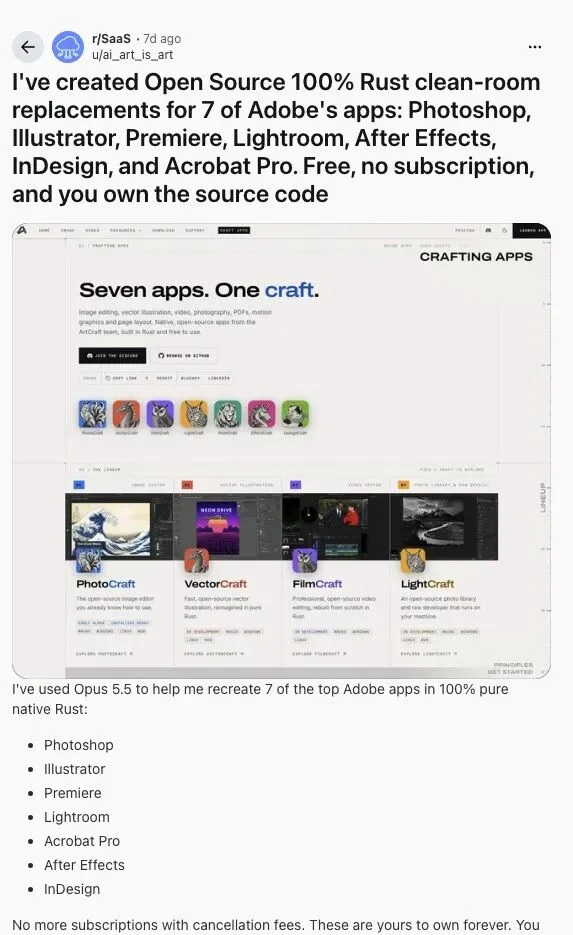
On Github, all of these repositories that provide “alternatives” are open-source and are written in Rust. They can be run locally on computers for free. Thomas stated that he has recreated seven Adobe products using Claude Opus 5.5 and promised to achieve full functional equivalence within one month.
Detailed information about all seven models can be found on the official website. For directions, please refer to 👉🏻 https://getartcraft.com/
Such a great news spread quickly on Reddit: “One person has used AI to replicate the entire Adobe suite of software.” In the past few decades, the research and development efforts of these software giants have been shortened by several days thanks to just one person and one model.
Thomas didn't suddenly learn how to code. As a beginner, he claims to have 15 years of development experience and has worked on large-scale software projects, with his earliest professional experience dating back to the payment software Square. Later on, in the field of generative AI, he developed a text-to-speech product that imitates the voices of celebrities. Subsequently, he continued to work on tools for generative AI that create controllable characters, shots, and actions.
From his resume, ArtCraft was a surprise. Each of the seven software products has its own page and download link, but five of them are still in the “development” stage. The PhotoCraft and PDF tools are marked as “early Alpha.”
Is “substitution” really that magical?
PhotoCraft first comes with tools for layers, masks, brushes, curves, and text. It’s important to get familiar with the interface layout and operation modes. The functions for opening and saving PSD files are also available. Screenshots, a list of features, and installation packages for various systems can be found on the official website. The code repository is constantly being updated to add new features and fix issues.
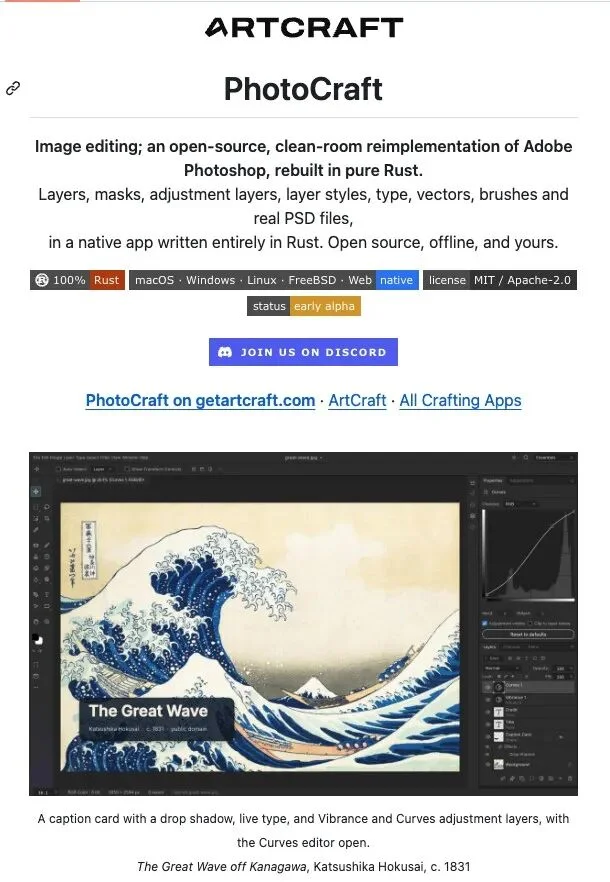
Obviously, this is a Photoshop-related product, and netizens have been downloading it to give it a try. Overall, it meets their expectations. PhotoCraft launches quickly and can open images, and the basic operations can be performed without issues. However, beyond that, the performance starts to become unsatisfactory. One user reported problems with PSD files that contain smart objects; another designer noticed that while a simple professional file can be opened, the operations are very slow, and there are frequent small errors. Users of FilmCraft have reported crashes when importing more video segments, as well as issues with the display of some materials.
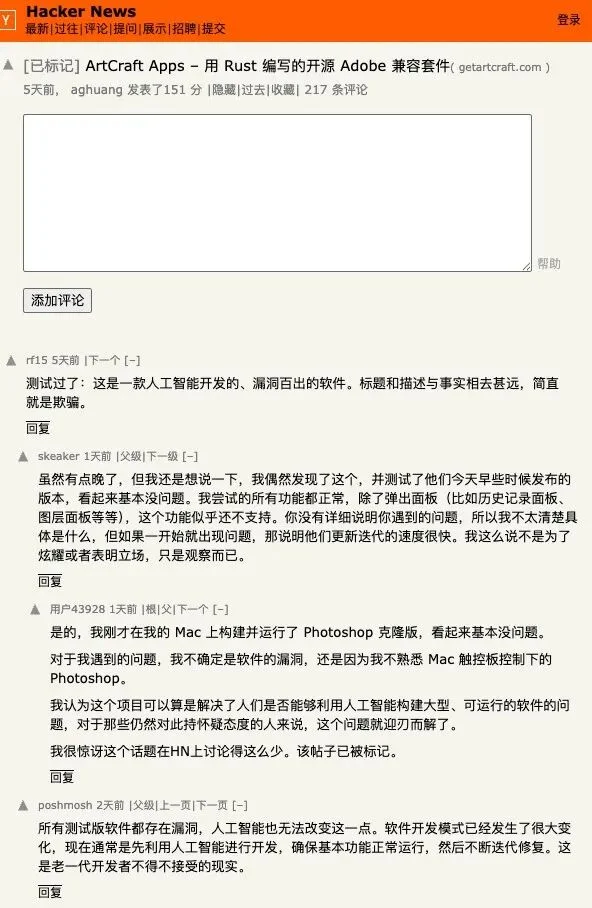
The timeline that Thomas initially proposed, which was to achieve 100% functional equivalence within one month, has been repeatedly postponed. In response to Hacker News, he later stated that approaching completeness and equality might be measured on a monthly basis, rather than being completed within a single month. He mentioned that his open-source project aims to gather a group of users to submit issues, test the software, and participate in the development process.
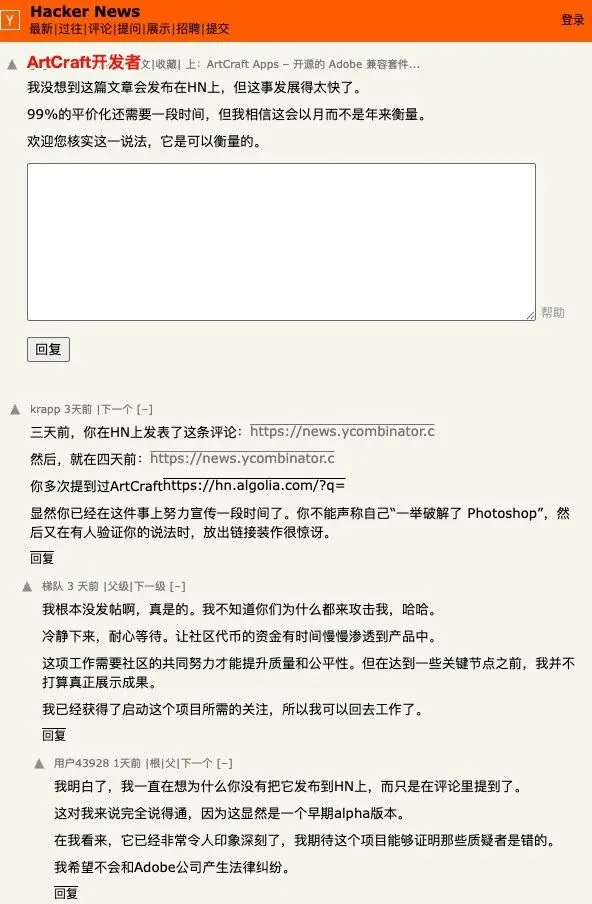
Hm? Why has it disappeared at this time? The super-fast development pace enabled by AI? Technically speaking, it is possible for a person to create seven programs that “can be used and look like Adobe software” in a short period of time with the help of AI.
But it's still possible for someone to catch up with the many years of research and development that Adobe has already invested.
Just two months ago, the Adobe Engineering Director publicly mentioned in a blog post that rewriting the entire structure of Photoshop would be almost impossible and also unnecessary.
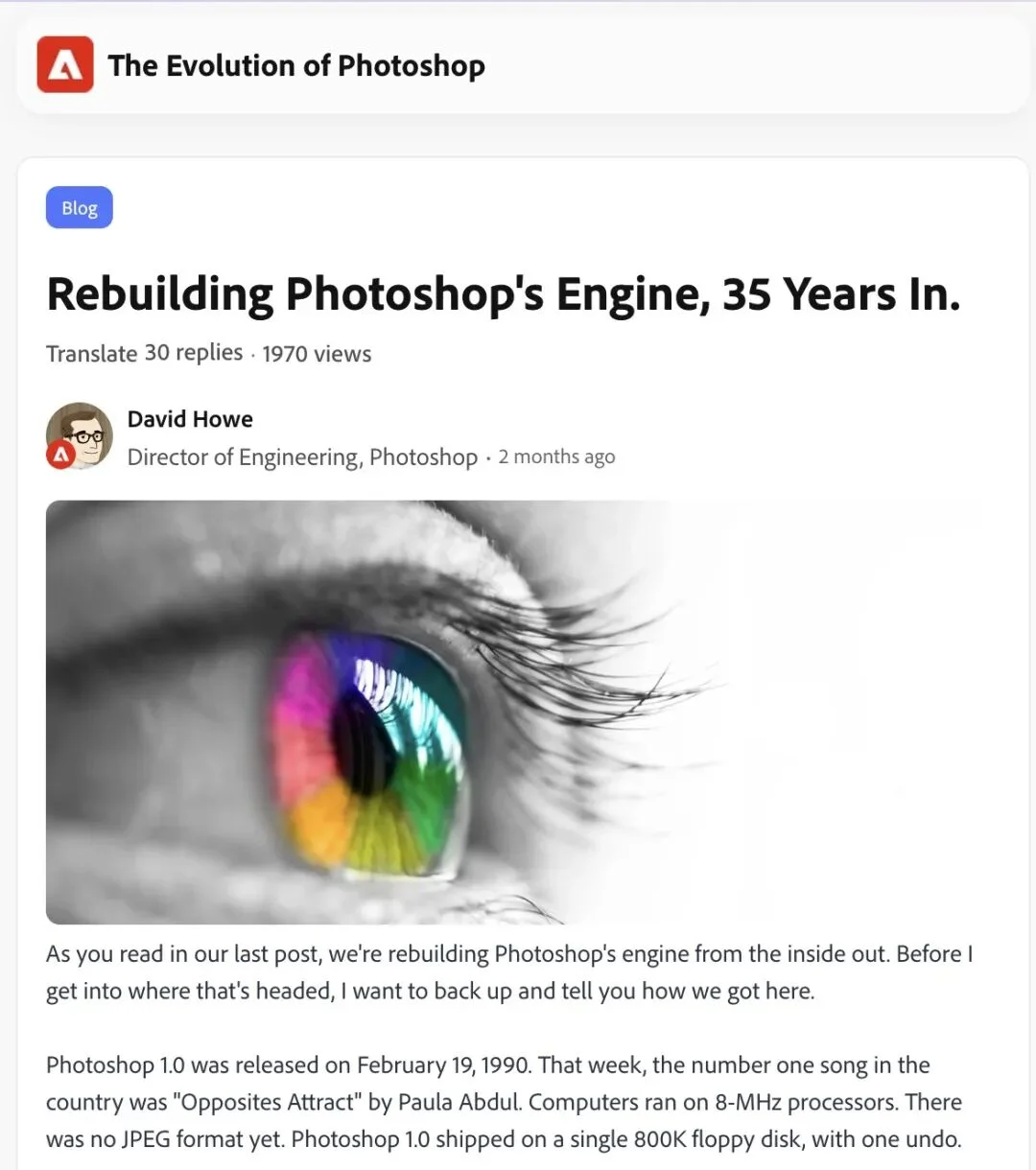
Of course, this statement is not referring to ArtCraft. Its original meaning is that Adobe has recently been completely reworking Photoshop from the inside out, gradually adding and updating its engine while maintaining the existing tools and capabilities. In 2016, when Apple released the iPad Pro, the hardware had developed to a level that could meet the needs of mobile devices. Adobe then ported Photoshop's existing codebase to mobile and web platforms, rather than rebuilding everything from scratch.
In fact, no one believes or expects that software developed using AI coding with a high probability of success can compete with Adobe. Free software is a good thing, and open-source software is also a good thing; however, being unrealistic is a bad thing.
For example, PhotoCraft is used to read and write different PSD files, perform image composition, apply filters, and split the interface using Rust modules – this represents a true software architecture. Repository tests show that the intelligent objects and filter information in the samples can be saved and re-read along with the files; however, when PhotoCraft recalculates the Photoshop filter effects, only one out of thirty test cases matches the expected implementation.
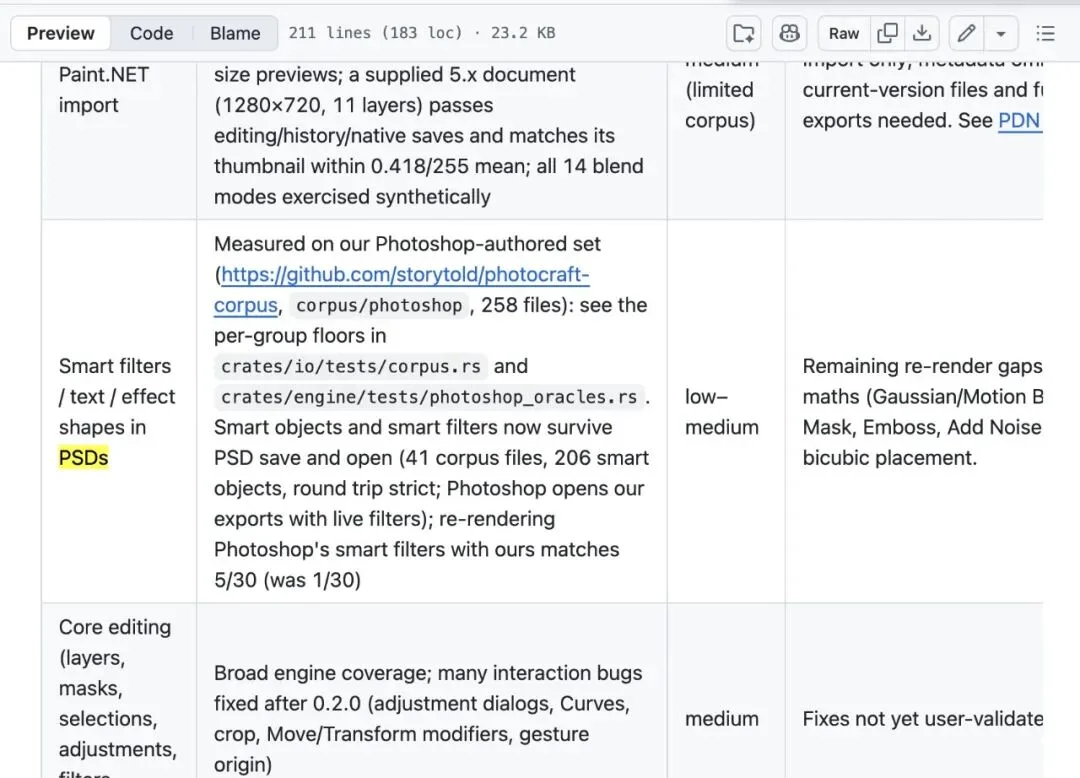
Photoshop’s Smart Filters represent a complete workflow where users repeatedly adjust parameters, order, blending modes, and masks. First, the layer must be converted into a “Smart Object” so that effects such as blurring and sharpening can be applied without directly overwriting the original pixels. Whenever the user adjusts the parameters or the order of the filters, Photoshop recalculates the image. Therefore, the fact that PhotoCraft can save and retrieve these adjustment records does not mean it can produce the same results.

Another example is the commonly used video editing software Premiere, which offers hardware-accelerated playback and export processes and supports various plugins. For editors, these plugins can significantly improve the coordination between different teams during post-production, as well as the efficiency of handling long media files and file transfers. Although Premiere can perform multi-track editing, color grading, exporting, video encoding/decoding, timeline editing, rendering, and other tasks using its built-in functions, as well as GPU acceleration, some effects and Lumetri color grading tools still require the use of the CPU, which can result in slow processing speeds. Additionally, third-party plugins such as VST3 and Audio Units need to be installed separately.
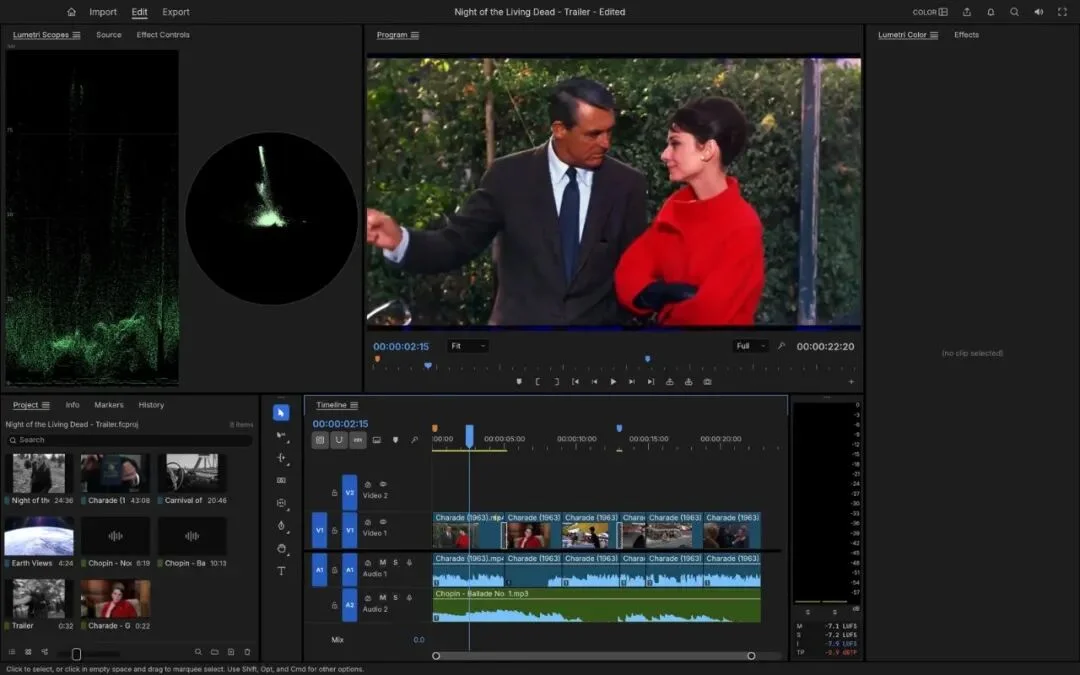
While "substitution" addresses these fundamental issues, Adobe's new generation of image processing engine is already in the planning stage. The goal of this engine is to integrate the combined operations of filters and layers within documents into the GPU programs during document compilation, thereby reducing the unnecessary generation of temporary bitmaps. The main challenges to be overcome are whether complex files can be edited in real-time and how to maintain image quality after repeated processing.
Generation after generation, the dream of slaying dragons has persisted...
In the past, people used to ask, “Why isn’t anyone using it? Why doesn’t AI create a Photoshop-like program?” Several projects that emerged later almost all aimed to compete with established, mature software.
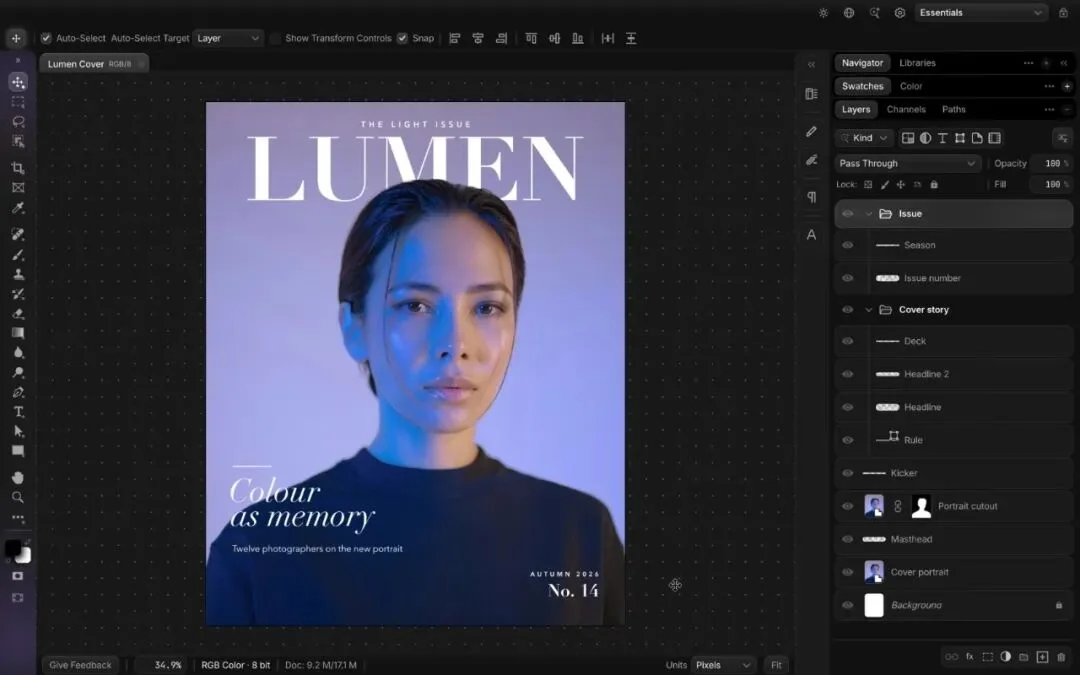
Photon Studio has also recently attempted to challenge the dominance of Photoshop in the AI coding field. Developers claim that the model costs around $2,000 to use. Tools like GPT-6 Astra, which are free image editing software, have attracted 170 active users on the first day. The developer also admitted that the initial version was flawed and unstable, and the software has been continuously improved through user feedback since its release.
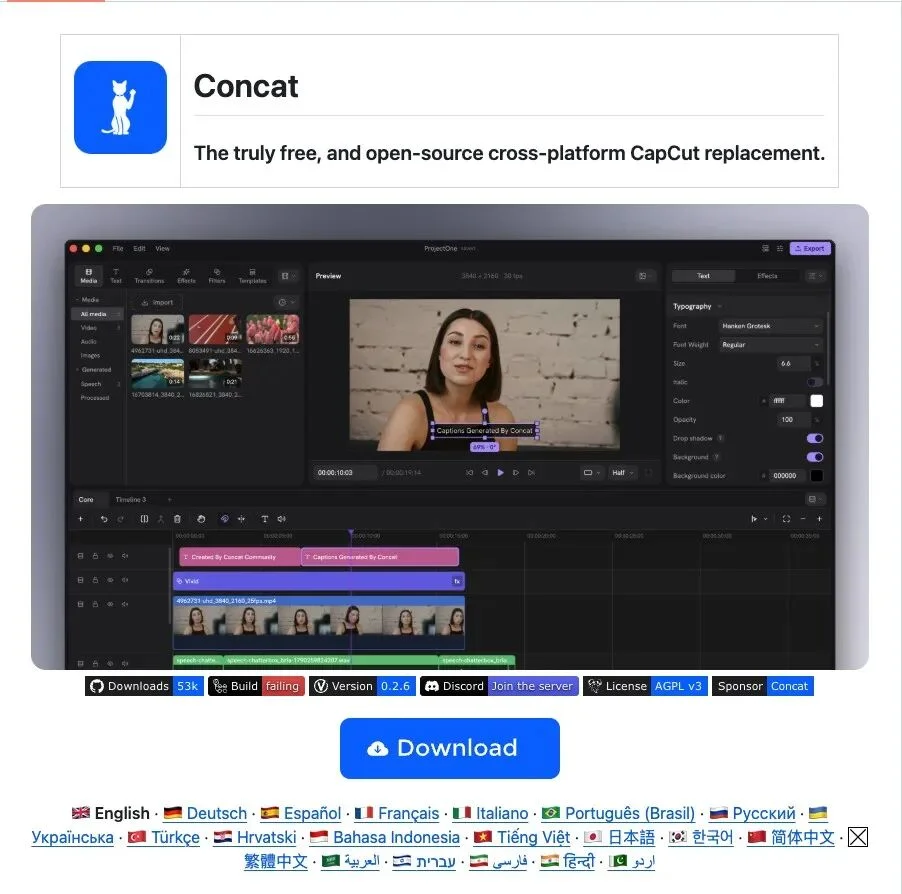
The international version of CapCut also had a feature called “Partial Replacement” (Concat), which is an open-source editing software using Claude Code that focuses on enabling users to run functions such as automatic subtitles and text-to-speech on their own computers. There is no need to continue paying a subscription fee to export videos.
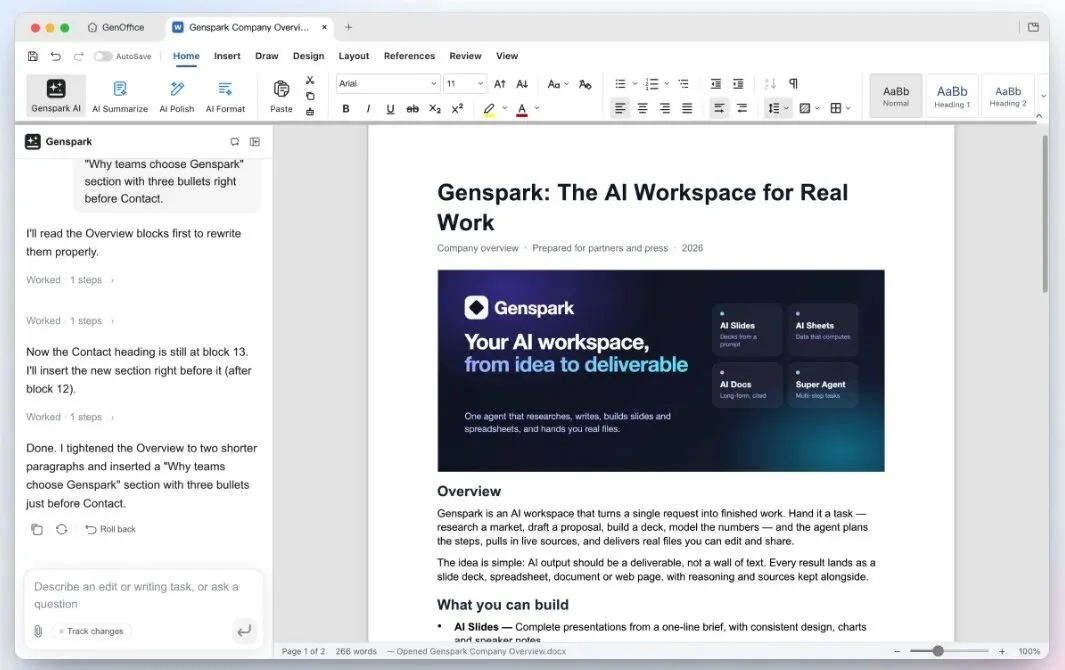
What's even more exaggerated is GenOffice; the project directly claims to be an open-source alternative to Microsoft Office, competing with Word, Excel, PowerPoint, and PDF files, and it integrates AI agents into the editing process.
AI coding is gradually becoming more popular, which has prompted many experienced developers to think of creating small tools to meet their daily needs. However, this represents a challenge to the accumulated capabilities of mature software that has been in use for decades, and in many cases, the amount of talk about this trend outweighs the actual action taken by developers.
In addition, these open-source projects are actually based on the principle of "welcoming joint development," aiming to complement the practical experience accumulated over countless real files, devices, and user interactions – you can't gain significant knowledge or skills all at once.
The AI coding for the graphic panel, filter menu, and file parsing programs can be developed quickly. However, there is a “Smart Filter” in the menu that ensures that even complex PSD files from ten years ago can be opened correctly, and after being saved, they can still be opened in Photoshop and further modified. These represent two different levels of completion.
AI coding has changed the way humans perceive the “degree of completion” of tasks. In the past, it would take a long time to redo things; for example, creating windows, toolbars, layers, and a few filters in Photoshop was a cumbersome process that developers found challenging. Now, these visible elements can be created within just a few days and can respond to user actions such as clicking, opening images, and exporting files. This software represents a significant advancement, as it is the first time that the final product looks like it’s actually finished from the very beginning – greatly reducing the time required for development.
Even if difficulties arise and several bugs are found, just let me know, Agent. In a few minutes, they will be fixed and the system will pass the tests. After going through this process dozens of times in a row, it’s easy to imagine that the remaining issues will just require running the system a few more times and burning up some tokens.
The most challenging part of mature software is often the exceptions that are not listed in the requirements or the repository. These exceptions arise from past feedback and may even come from the future; they require insight to identify and resolve, rather than just dealing with more tokens.
The article is sourced from "APPSO", and the author is "APPSO".
Article link:https://airai.cc/en/ai-news/59/
有用吗?