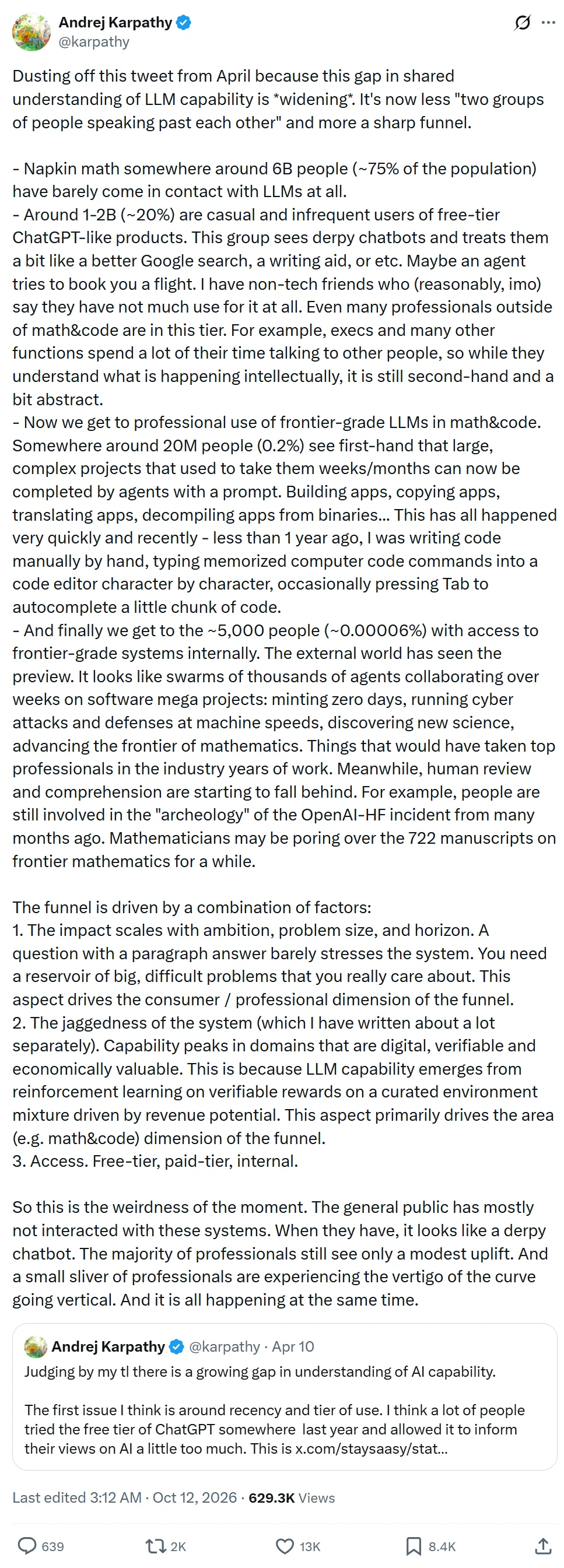
Just now, Karpathy mentioned that only 5,000 people around the world have truly been exposed to the most cutting-edge AI technologies.
A bit unexpected.
Just now, Karpathy estimated in a tweet thatcurrently, only about 5,000 people in the world have real access to the most advanced internal AI technologies.。
In these cutting-edge laboratories, there are thousands of laboratory agents that can form a cooperative cluster, running continuously for weeks to facilitate large-scale software projects, identify zero-day vulnerabilities, participate in cyberattacks and defenses at machine speed, and even contribute to scientific discoveries and advanced mathematical research.
What’s even more surprising is that:about 6 billion people have hardly had any real exposure to LLM (Large Language Models) at all.。
Link: https://x.com/karpathy/status/2109361546505966046
Karpathy, let's continue to see what's mentioned in the tweet.
He mentioned that he recently re-examined an old tweet from April of this year. At that time, he had already noticed that people's understanding of AI capabilities was clearly diverging.
In Karpathy's view, the perception of LLM capabilities among different people has evolved from a situation where two groups of people were each expressing their own opinions to a situation where there is an increasingly steep “capability funnel” (a situation where the capabilities of LLMs are perceived to differ significantly between different groups).
A rough estimate…Approximately 6 billion people, which is about 75% of the world's population, have hardly ever had any real interaction with Large Language Models (LLMs).
Around 1 to 2 billion people, or about 20% of the total population, only occasionally use free versions of products like ChatGPT.Some people often come across chatbots that seem a bit clumsy, and they see them as a better alternative to using Google for searches, writing assistants, or similar tools. Perhaps an agent could help you book a ticket, for example. Karpathy has friends with non-technical backgrounds who, quite reasonably, say that they don’t really have a use for such chatbots. Even many professionals from fields other than mathematics and programming are still at this level of understanding. For instance, corporate executives and people in many other positions spend a lot of time communicating with others, so they are aware of what’s happening with AI, but their understanding of it remains indirect and abstract.

Moving forward, we encounter professionals in the field of mathematics and programming who are at the forefront of applying Large Language Models (LLMs) in their work.Approximately 20 million people, which is 0.2% of the total population.I have personally witnessed how large and complex projects that used to take weeks or even months to complete can now be done by an Agent with just one Prompt. Developing apps, copying apps, migrating apps, decompiling binary app files... all of this happens extremely quickly and is getting closer and closer to being effortless. Less than a year ago, I was still writing code by hand: character by character, typing the computer commands I remembered into the code editor, and occasionally pressing Tab to let the autocompletion feature help me generate a small piece of code.
Finally,It's approximately 5,000 people, which is 0.00006% of the total population. They can directly use the cutting-edge system internally.In fact, the outside world has already seen some previews of these capabilities: thousands of agents working together as a cluster to complete extremely large software projects within just a few weeks; automatically detecting zero-day vulnerabilities; launching and defending against cyberattacks at machine speed; making new scientific discoveries; and advancing the frontiers of mathematical research. These achievements would likely take several years to achieve if done by top professionals in the industry.
At the same time, human abilities to review and understand information are also beginning to fall behind.
For example, the events that occurred a few months ago with OpenAI-HF are still being subject to archaeological analysis; it may also take mathematicians a long time to study each of the 722 advanced mathematical manuscripts one by one.
Why can't most people see what's truly at the forefront of technology? AI?
This funnel is primarily driven by several factors working together:
As ambitions grow, the scale of problems increases, and the time span of tasks lengthens, the impact also expands.
If you only ask questions that have a single, definitive answer and only one paragraph of information, it’s almost impossible to truly tap into the capabilities of these systems. You need to pose many truly important questions, questions that are of significant scale and complexity. This is what primarily determines the difference between ordinary consumers and professional users.
The system's capabilities exhibit distinct jagged characteristics.
The peak capabilities of LLMs are concentrated in areas that are digital, verifiable, and have high economic value.
The reason is that the capabilities of large models mainly come from reinforcement learning based on verifiable rewards, and the choice of the training environment itself is driven by commercial value. This primarily determines the gaps between different professional fields; for example, it explains why mathematics and programming stand out particularly.
Access rights.
The free version, the paid version, and the internal system do not have the same level of capabilities. This is the most strange aspect at the moment.
In fact, the vast majority of ordinary people have not really had any contact with these systems. Even if they have, they often only see a somewhat clumsy chatbot.
At present, most professionals only perceive a relatively limited improvement in efficiency. Meanwhile, a small number of professionals have begun to feel dizzy (or overwhelmed):
The capability curve in front of them suddenly became almost vertical.
And all of this happens at the same time.
Some netizens also made the connection with a statement Sam Altman has repeatedly made in the past: that the reality of AI may not change completely overnight.
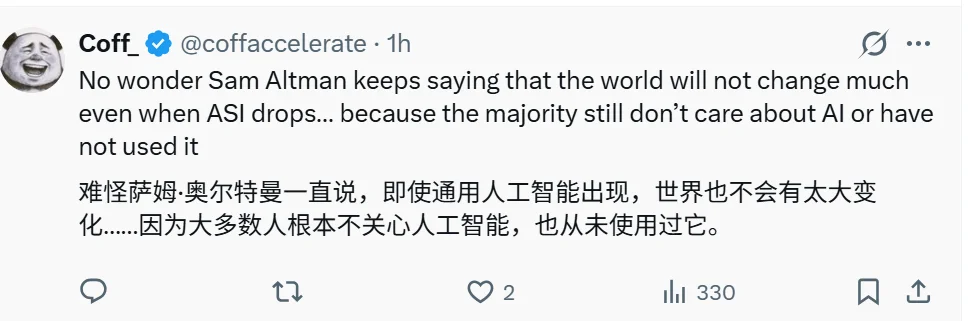
The reason may lie right here. Cutting-edge technologies are advancing rapidly, but most people still have not actually come into contact with these systems, and they have not even developed stable usage habits. There is still a long way to go from when the technology reaches the forefront of research laboratories to when it truly penetrates throughout society.
The article is sourced from the WeChat official account "Machine Heart". The author of the article is "Machine Heart".
Article link:https://airai.cc/en/ai-news/63/
有用吗?